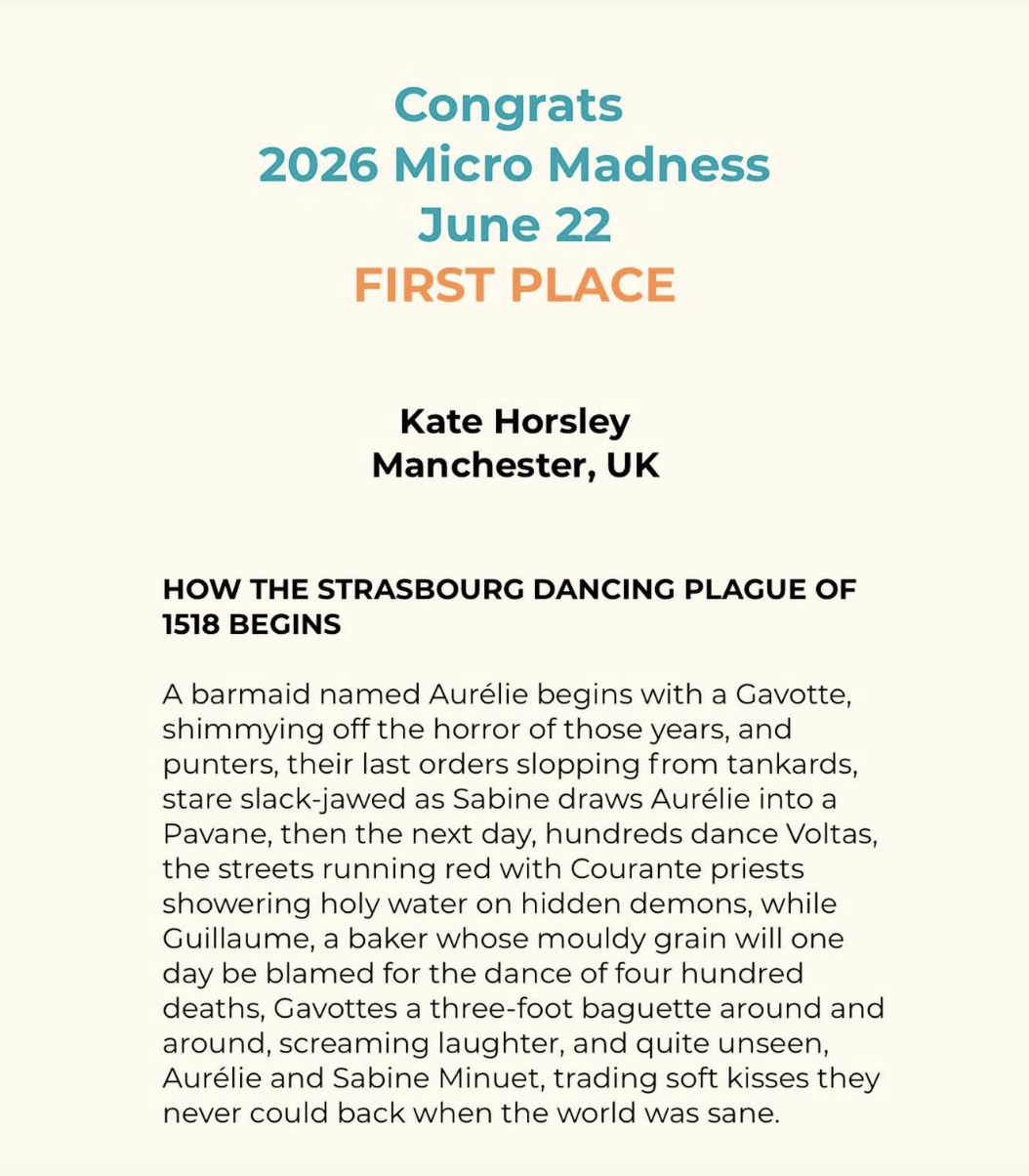
Made my whole week to learn that ‘How the Strasbourg Dancing Plague of 1518 Begins’ took First Place in this year’s Micro Madness, National Flash Fiction Day NZ’s daily micro-fiction celebration! Huge thanks to wonderful judges Tim Saunders and Tania Hershman for picking a piece about medieval barmaids, forbidden kisses and a genuinely real historical dance plague to close out the competition on the solstice itself. Wonderful company all month — go and read the whole longlist if you have a spare hour, it’s a treat.
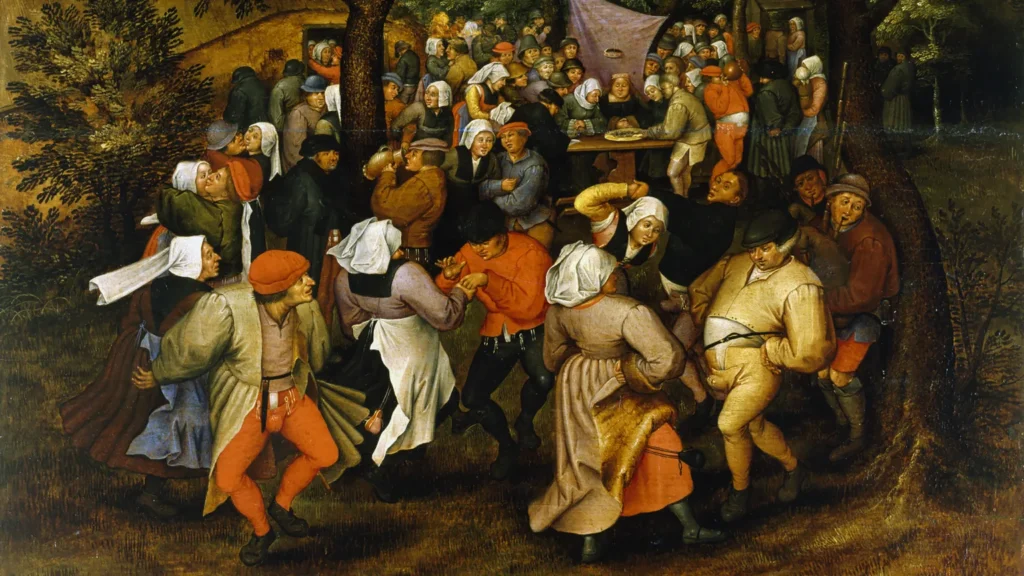
The story is rooted in one of history’s strangest real events: in July 1518, a woman called Frau Troffea stepped into a street in Strasbourg and began to dance, and simply couldn’t stop, dancing alone for nearly a week before dozens of others were seized by the same compulsion. By the end of the month, several hundred people were dancing uncontrollably, many collapsing from exhaustion. Nobody agrees on why. At the time, many blamed a curse from St Vitus, the patron saint of dance, or an excess of “hot blood” that needed dancing out. The town council even hired musicians and built a stage, which, unsurprisingly, made things worse! Modern theories range just as wildly, from mass psychogenic illness brought on by famine, disease, and a punishing few years for the region to a hallucinogenic fungus called ergot that can grow on poorly stored rye. Some accounts of the whole affair may have been exaggerated or reshaped by the various chroniclers and physicians recording it centuries later.
I found all of that uncertainty completely irresistible to write into! For the story, I invented my own fictional ‘first dancer’, a barmaid named Aurélie, and since I was writing this queer historical micro during Pride month, I wanted to imagine her finding her way, amid all that fear and chaos, into her joyful first kiss and with Sabine, another woman.
You can read more about the real story at the Guardian, Big Think, and History Facts.